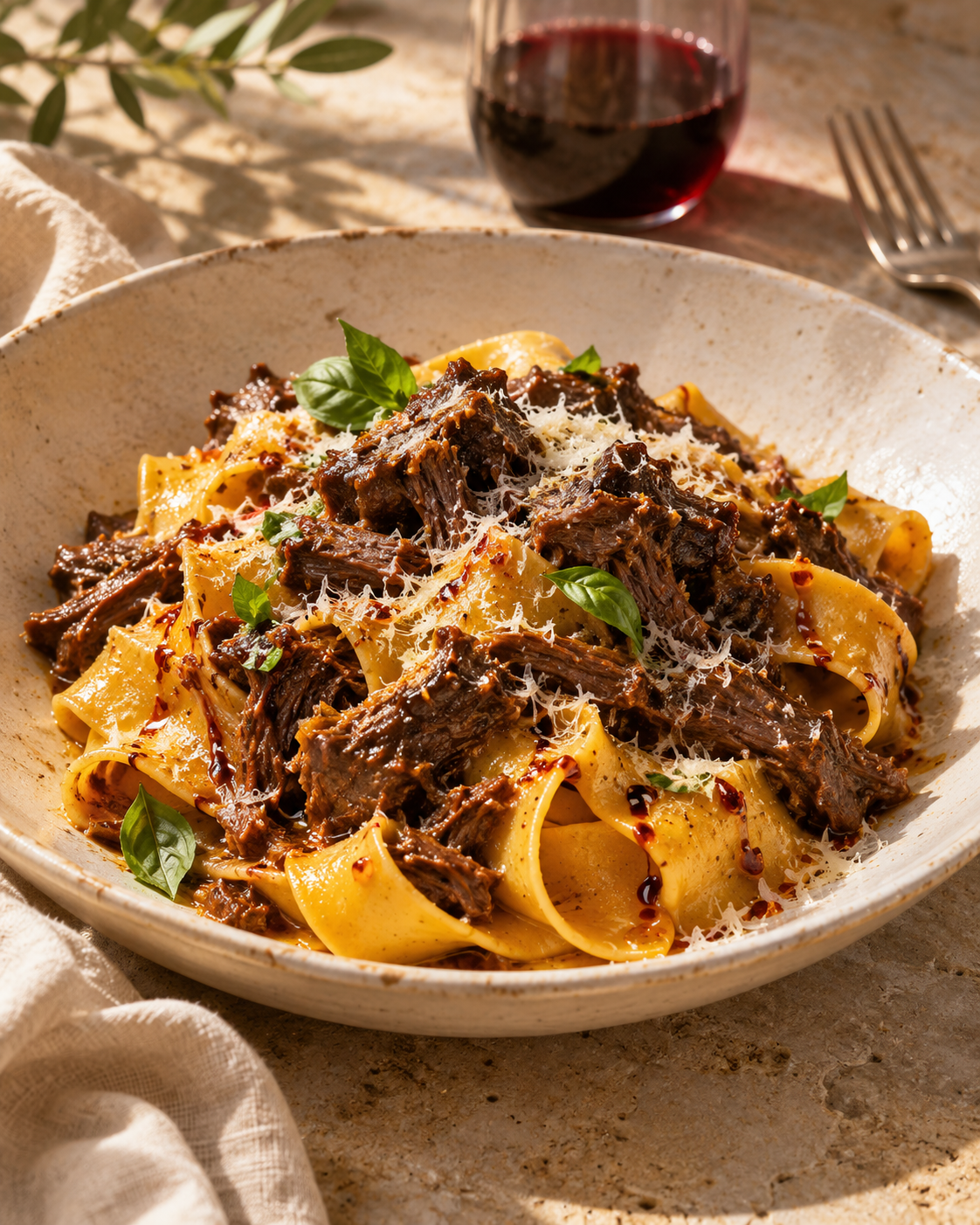
Rich, luscious and very meaty. Slowly braised short ribs soften into a dark, deeply flavoured ragù, ready to spoon over broad ribbons of egg pasta.
I like to serve each plate individually, then grate the Pecorino, tear the basil and finish with balsamic and chilli olive oil. A few small touches that make it your own.
01 / FROM ZACHARY’S KITCHEN
The little things that make a difference.
My ingredient preferences and a few useful tips before you begin.
My favourite ingredients +
The beef. I go to Bowie Meat & Co. in Robina and ask the butcher to cut three large bone-in short ribs in half.
The wine. I’ve used Gran Sasso Edizione Limitata Montepulciano d’Abruzzo Terra Vera a few times. I get it from Somm in Nobby’s Beach; it’s not expensive.
The celery. My bunches are usually quite large, so I judge the amount by volume and aim for roughly equal parts carrot and celery.
A few things worth remembering +
Dice the vegetables finely, brown the beef well and judge the braise by tenderness rather than the clock. Keep the sauce thick and meaty, adding broth only as needed.
Remove the bones, Parmesan rind, bouquet garni, loose stems and bay leaves. Taste before adding salt: the rind and Pecorino both contribute seasoning.
Make ahead & another meal +
Cook only the pasta you need and keep it separate from any ragù you intend to save. The sauce can be made ahead, refrigerated or frozen, then reheated. It also works over rice.
Finish each serving with freshly grated Pecorino, torn basil, balsamic and chilli olive oil just before serving.
A small kitchen glossary +
Sofrito. The finely diced vegetable base; often spelt ‘soffritto’ in Italian.
Julienne. Fine, matchstick-like strips. Brunoise. A very fine dice.
Fond. The flavourful browned bits left in the pot after searing.
Bouquet garni. A bundle of herbs tied with kitchen twine, ready to lift out after cooking.
Al dente. Pasta cooked with a little firmness left in the bite.
The Italian name +
Pappardelle al ragù di costine di manzo means pappardelle with beef short rib ragù. The Italian title describes the dish; the ingredients and finishing touches here are my own version.
02 / GATHER YOUR INGREDIENTS
A few good things.
The exact ingredients I use, right down to that extra quarter of a can.
A closer look at the cut I use
0 of 25 ingredients checked
For the ragù
For the pasta & finishing
A note on measurements. Use the gram and millilitre quantities where provided. The wine and broth amounts follow this recipe’s original measurements, rather than Australian 250 mL cups. Servings depend on the size of your short ribs and how much pasta you cook.
03 / READY THE KITCHEN
What you’ll need.
Le Creuset Cast Iron Round Casserole with a lid — my choice for this ragù. A large, heavy-based, ovenproof pot with a lid is an alternative.
Kitchen twine for the bouquet garni
A large bowl for shredding the meat
A fine microplane for the Pecorino
A large pot for cooking the pasta
04 / TAKE YOUR TIME
From pot to plate.
Twelve steps to a very good meal. Read through below, or open the cooking view for one step at a time.
01
THE FOUNDATION
Prepare the sofrito
The carrot, celery and onion form the sofrito, the finely diced vegetable base that will soften and melt into the sauce.
Peel the carrots and cut them into manageable lengths. Slice into thin planks, stack the planks, then cut into fine julienne strips. Line up the strips and cut across them to create a very fine dice, close to a brunoise. Mince a little further if needed.
Repeat with the celery, keeping the pieces approximately the same size. Aim for roughly equal quantities of carrot and celery. Finely dice the brown onion.
Crush the garlic with the flat of a knife, then run your knife through it a few times in each direction until finely chopped.
02
APPROX. 2 MINUTES PER SIDE
Season and sear the beef
Preheat the oven to 175°C fan-forced. Season the short rib pieces on all sides with Tasman Sea Salt Flakes and freshly ground black pepper.
Heat the 2½ tablespoons of avocado oil in the Le Creuset Cast Iron Round Casserole (or a large, heavy-based, ovenproof pot) over medium–high heat. When hot, add the beef and press it down gently to make good contact. Work in batches if necessary.
Sear for approximately 2 minutes per side, or until you have a deep, beautiful brown crust. You are looking for colour, not to cook the meat through. Browning two broad sides is sufficient; there is no need to sear every side or the bones.
Remove the beef and set aside.
03
APPROX. 2 MINUTES
Sweat the vegetables
Reduce the heat to medium. Add the onion, carrot, celery and garlic to the pot. Season lightly with salt to help draw out the moisture, then stir through the beef fat and fond.
Sweat the vegetables for approximately 2 minutes, until they begin to soften.
04
APPROX. 1–2 MINUTES
Toast the tomato paste and harissa
Add the 30 g Mutti Double Concentrate Tomato Paste and 30 g Chef’s Choice Fresh Harissa.
Keep the heat at medium and stir everything together, allowing the pastes to toast and caramelise for approximately 1–2 minutes. The harissa adds richness and a little spice, while the tomato paste colours the vegetables a deep, luscious red.
Once the mixture starts to stick lightly to the bottom of the pot, add the 1¼ cans of Mutti Polpa Finely Chopped Tomatoes. Stir well, taking care not to let the pastes burn.
05
BUILD THE BRAISING LIQUID
Add the wine, broth, balsamic and chocolate
Increase the heat to high and pour in the 473 mL dry red wine. Stir and bring to the boil.
Follow with the 591 mL beef bone broth and 30 mL Cintra Estate Balsamic Vinegar.
Add 1 square of Lindt Excellence 85% Cocoa Dark Chocolate and stir until it melts into the braising liquid.
Scrape up the browned bits from the bottom of the pot so all that flavour becomes part of the sauce. Bring to the boil, then reduce the heat to a gentle simmer.
06
READY FOR THE OVEN
Add the Parmesan rind, beef and bouquet garni
Add the Parmesan cheese rind, nestling it into the braising liquid. Return the beef to the pot, placing the short rib pieces bone-side down.
Make a bouquet garni by gathering the 4 sprigs of oregano, approximately 15 sprigs of thyme and 2 bay leaves into a small bundle. Tie securely with kitchen twine so the herbs are easier to remove later.
Nestle the herb bundle into the sauce. Once the liquid returns to a simmer, cover the pot with a lid.
07
3–3½ HOURS · 175°C FAN-FORCED
Braise until the beef falls apart
Transfer the covered pot to the oven and cook for approximately 3–3½ hours, or until the beef is exceptionally tender.
The meat should almost jiggle, and pressing it with a spoon or fork should start to break it apart. The braising liquid should have become a luscious, dark sauce, enriched with the flavour and fat from the beef.
The vegetables should be very soft, almost purée-like in consistency. Check during cooking that there is still sufficient liquid in the pot. Add a little extra broth if needed.
08
USE A LARGE BOWL
Remove and shred the beef
Carefully transfer the meat to a large bowl, leaving as many vegetables as possible in the pot.
Remove the bouquet garni and Parmesan rind. Check that both bay leaves and any loose herb stems have been taken out. Remove the short rib bones and any unwanted membrane from the underside of the ribs.
Allow the beef to cool enough to handle, or use spoons or forks to shred it. If properly tender, you should be able to shred it with a spoon. Press and twist gently, unwinding the softened fibres.
Shred it finely for a cohesive, juicy ragù, or leave it chunkier if that is your preference.
09
TASTE AND ADJUST
Bring the ragù together
Stir the sauce, allowing the softened vegetables and tomatoes to break down further. Return the shredded beef to the pot and mix thoroughly so the sauce coats and rehydrates the meat.
You can reserve a little beef to place on top of the finished pasta if you have a surplus. If the ragù has reduced too much, add a little extra beef bone broth at a time until it reaches the consistency you want.
Keep it relatively thick: this is meant to be a very meaty sauce. Taste and adjust the salt and pepper, remembering that the Parmesan rind has already added seasoning and the Pecorino will add more salt when you finish each plate.
10
FOLLOW THE PACKET TIMING
Cook the pappardelle
Bring a large pot of salted water to the boil. Add the Deciova Pappardelle di Campofilone egg pasta and cook according to the packet instructions until al dente, with a little bite remaining.
Use approximately 454 g pasta for 4 generous servings, or up to 908 g for 8, depending on appetite and how much ragù you have.
Before draining, reserve ½–1 cup of the cooking water in case you need to loosen the sauce. Drain the pasta and prepare to serve straight away.
11
MY PREFERRED WAY TO SERVE
Plate each serving individually
I typically prefer to serve each plate individually. Divide the freshly cooked pappardelle between plates or shallow bowls, then spoon a generous amount of the hot ragù over each portion, including some of its rich sauce.
If you have reserved a little extra shredded beef, add it on top.
Optional tossing method: Gently toss the cooked pasta with the ragù before dividing it between plates. Add a small splash of reserved pasta water only if needed to loosen the sauce.
12
PECORINO · BASIL · BALSAMIC · CHILLI
The finishing touches
Using a fine microplane, freshly grate the Pecorino Romano over each serving, creating a light, delicate ‘Pecorino dust’.
Roughly tear the fresh basil leaves and scatter them over the top. Add freshly cracked black pepper, then drizzle with a little Cintra Estate Balsamic Vinegar.
Finally, finish with a drizzle of Willow Vale Gourmet Food Co. Chilli Olive Oil, adjusting the amount to taste. Serve immediately.